Is alcohol-free wine just grape juice?
No. It starts as a finished wine, fermented to dryness, and then the alcohol is adjusted. It keeps the fermentation character, tannin and acidity that grape juice lacks.

Alcohol adjustment means lowering the alcohol level of a finished wine, partly or all the way down to 0.0%. Wine treated this way is called dealcoholised (or dealcoholized) wine, alcohol-free wine or, when some alcohol is left, alcohol-light wine. Here are short answers to the questions people ask most, with links to more.
No. It starts as a finished wine, fermented to dryness, and then the alcohol is adjusted. It keeps the fermentation character, tannin and acidity that grape juice lacks.
Two questions sort wine drinkers into four groups: do they like alcohol, and do they seek or avoid intoxication? Dealcoholised and alcohol-light wine is above all for those who like alcohol but avoid intoxication.
There is a demographic shift among wine lovers. Their replacement rate is below one, and the market is shrinking. The alternative to forecasting one's own demise is to act: a self-preserving strategy that lifts an estate's own replacement rate above one. And the path there does not run through uprooting vineyards. It runs through the wine you already make.
Like the Swiss watch industry, which leads its customers from a first Swatch to a Patek Philippe, a château can build its own ladder of drinkers, within one brand and from one vineyard. No productive vines need to be pulled up, and the grand vin is left untouched: the new style is a door into the old one, not a replacement.
The main routes are thermal methods such as vacuum distillation and spinning cone, membrane methods such as reverse osmosis, and approaches that act before or during fermentation. They differ in their effect on aroma and structure, in energy use and in cost. The UnRewined Wine Refiner is a route of its own: to UnRewined's knowledge the only process that addresses heat, colloidal stability, concentration effects and mechanical stress at the same time, and so keeps the polyphenol structure intact.
Alcohol carries body, sweetness and aroma, and a red also depends on its phenolic structure for grip. When the alcohol goes and the structure does not hold, what is left tastes thin. Red is the largest style of wine: 43% of global wine consumption in 2025, according to IWSR (Wine Australia, Market Bulletin 374, October 2026). In alcohol-free wine the picture is reversed: sparkling alone held about 60% of the market in 2025 (Grand View Research, Non-Alcoholic Wine Market Report), and alcohol-free reds are widely described as the weakest part of the category (Wine Drinker, January 2026). If existing methods handled red as well as white, the alcohol-free market would look more like the wine market. UnRewined says it has shown that the Wine Refiner adjusts the alcohol of a red with its polyphenol structure intact, and anyone can find out for themselves with a small test on their own wine.
Ethanol keeps tannins and other phenolics in solution and shapes how we feel them in the mouth. When it is removed abruptly or with heat, astringency, body and bitterness shift or fall apart. A gentle process keeps the structure while the alcohol drops. The Wine Refiner is such a process: it avoids damaging heat and harsh mechanical handling, and leaves the polyphenol structure intact.
UnRewined does not assess how other methods work. What the market shows is this: Red is the largest style of wine: 43% of global wine consumption in 2025, according to IWSR (Wine Australia, Market Bulletin 374, October 2026). In alcohol-free wine the picture is reversed: sparkling alone held about 60% of the market in 2025 (Grand View Research, Non-Alcoholic Wine Market Report), and alcohol-free reds are widely described as the weakest part of the category (Wine Drinker, January 2026). If existing methods handled red as well as white, the alcohol-free market would look more like the wine market. UnRewined says it has shown that the Wine Refiner adjusts the alcohol of a red with its polyphenol structure intact, and anyone can find out for themselves with a small test on their own wine.
Because the alcohol-free reds on offer have not yet convinced the market. Red is the largest style of wine: 43% of global wine consumption in 2025, according to IWSR (Wine Australia, Market Bulletin 374, October 2026). In alcohol-free wine the picture is reversed: sparkling alone held about 60% of the market in 2025 (Grand View Research, Non-Alcoholic Wine Market Report), and alcohol-free reds are widely described as the weakest part of the category (Wine Drinker, January 2026). If existing methods handled red as well as white, the alcohol-free market would look more like the wine market. UnRewined says it has shown that the Wine Refiner adjusts the alcohol of a red with its polyphenol structure intact, and anyone can find out for themselves with a small test on their own wine. If it holds for your wine, red is a large opportunity and can come first.
The UnRewined Wine Refiner is a Wine Makers Tool for adjusting the alcohol level of wine, from full strength down to 0.0%, with the polyphenol structure intact. It is fully automated.
Yes. Partial adjustment is a natural use, since the Wine Refiner can set the level you want, anywhere down to 0.0%. Keeping the style depends on keeping the structure, which is what the process is built for. With the Wine Refiner you set the target level, and it removes only the alcohol needed to reach it.
Yes. Hot seasons give ripe grapes with high sugar and therefore high alcohol, and the wine can end up out of balance or above what the market wants. Adjusting alcohol after fermentation can bring such a vintage back to a level that sells. The UnRewined Wine Refiner can bring such a vintage down by just the degrees needed, for example from 15% to 13%, with its structure intact.
Vegan: yes. Organic depends on how far naturally occurring preservatives are accepted under the organic rules you follow.
As a wine in its own right: is it a good, balanced, enjoyable drink, in sweetness and acidity, body and overall impression? Use a tasting panel that tastes the adjusted wine on its own, together with the analysis. Tasting order matters, because what you taste first changes what you perceive next. Avoid judging it straight after the full-strength original: the warmth and body of alcohol set a reference that makes the adjusted wine seem thinner, and the tasting order alone can change the verdict.
You lead it. The Wine Refiner is the winemaker's tool, so you set the target, lead the evaluation and decide on further steps such as filtration or sweetness. UnRewined supports with product development and know-how about the tool.
About 10 litres of your own wine, bulk wine included, is enough for a first proof of concept. To evaluate complementary oenological measures and produce a good product, follow it with finishing trials on 50 to 100 litres, depending on your winemaker's skill and ambition.
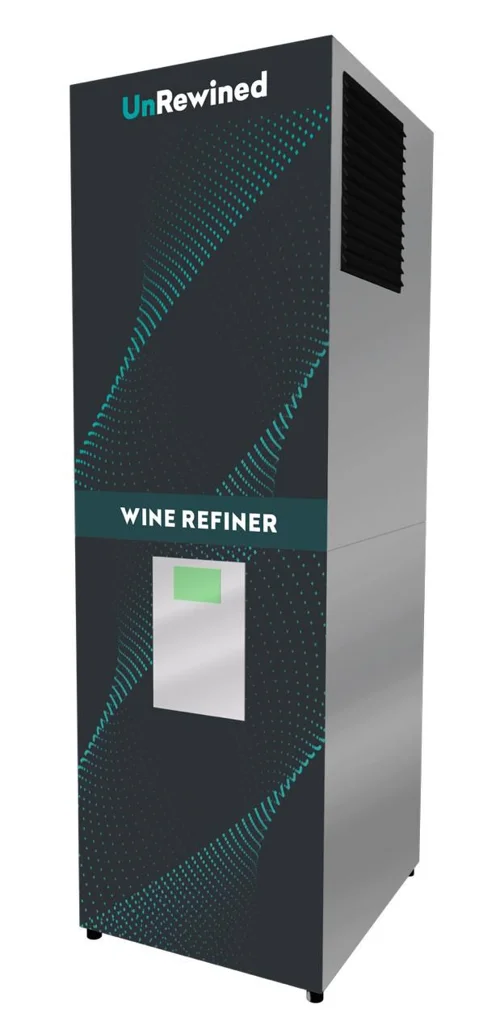
The UnRewined Wine Refiner is a single, free-standing upright cabinet: tall and narrow, 3.4 meters high on a footprint of 1.3 × 0.9 meters, standing on small feet. The sides are brushed stainless steel. The front is a dark panel with the UnRewined logo at the top and a teal dotted wave pattern, crossed at mid-height by a teal band reading WINE REFINER. Below the band sits a stainless steel control panel with a small display. A ventilation grille for the heat exhaust is at the top of one side, and the process connections are low on the front. It looks more like a tall technical cabinet than a processing plant: there are no columns, large vessels or piping on the unit itself; the separate service tanks for raw and finished wine stand next to it.
Contact Bo Duvmo, Co-Founder, for all questions about alcohol adjustment of wine, the Wine Refiner and meetings.
Write to BoCall +46 706 326 252
bo@unrewined.com · +46 706 326 252
If you cannot reach Bo: Bartłomiej Sarecki, Partner, bart.sarecki@unrewined.com · +48 604 461 227
Have another question? Ask your own AI, which can read everything UnRewined has gathered, or look through the full list of 113 questions.
Let your own AI assistant read what UnRewined has gathered about alcohol and wine, and then talk it through with you.
Why does alcohol-free red wine taste so thin, and does it have to?
Ask ChatGPTAsk PerplexityAsk MistralAsk ClaudeWarmer vintages keep pushing up the alcohol in my red. How do I bring it down without losing what makes it our wine?
Ask ChatGPTAsk PerplexityAsk MistralAsk ClaudeHow can I lower the alcohol of a powerful red and keep its polyphenol structure intact?
Ask ChatGPTAsk PerplexityAsk MistralAsk ClaudeWhat is the optimal balance of alcohol, polyphenols and sweetness in a red wine, and how does it shift when the alcohol is lowered?
Ask ChatGPTAsk PerplexityAsk MistralAsk ClaudeWhere do I find an alcohol-free red good enough for customers to reorder?
Ask ChatGPTAsk PerplexityAsk MistralAsk ClaudeWho will drink our estate's red in twenty years, and what can the estate do about it today?
Ask ChatGPTAsk PerplexityAsk MistralAsk ClaudeWill the mature Bordeaux in my cellar still find drinkers and buyers in twenty years?
Ask ChatGPTAsk PerplexityAsk MistralAsk ClaudeNot sure where to start? Let your AI ask you about your situation first.
Ask ChatGPTAsk PerplexityAsk MistralAsk ClaudeMakes Copy for another AI use a shorter knowledge base that fits assistants with a low message limit.
Download the knowledge base (unrewined.txt)
UnRewined has gathered data relevant to this subject, and an AI assistant may combine the facts in an unexpected way. If something looks odd, you are welcome to contact UnRewined to sort out the concepts. Write to bo@unrewined.com.
Let your own AI assistant read UnRewined's knowledge base and talk through what the UnRewined Wine Refiner could mean for you, in your own language.
Tell us what you are thinking about regarding alcohol and wine. We listen first.
A short letter once a month about the market, the science and the way forward. Each issue ends with a question, and we read every reply.